Sound, Always On and Present
Observing non-visual playlists, remix, and rain
Hi all, this week’s post takes a slightly different shape than usual —

Soundtrack Repeat
— it must be annoying, for those around me, when I play music on repeat during creative pursuits. Hello, headphones. There’s something gratifying, I think, in having a soundtrack for every project. Hearing the familiar rhythms, styles, and moods can transport oneself into a certain mindset; this can be particularly useful when moving through various projects and it’s a way to re-focus the mind. A particular playlist can also influence one’s selection of graphics or words. On the downside, though, it also means that hearing certain songs might bring to mind a project that’s better off forgotten.
Lately, I favor listening to instrumental music that is rather minimalist, such as Hania Rani or Ludovico Einaudi. Chance discoveries such as the one full album by Tangled Tape, played on my laptop over and over and over, transport me back to the summer of 2020. Many songs trickle through time, and my list could go on. Is it possible for music or sound to be outside of an experience —

Book Plate
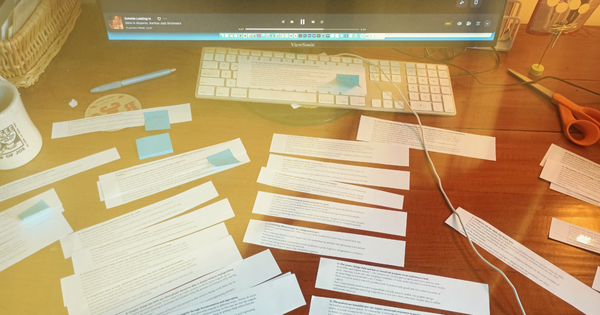
— my copy of Sound Unbound: Sampling Digital Music and Culture edited by Paul D. Miller (DJ Spooky That Subliminal Kid) shows many signs of wear and tear, its pages dog-eared and peppered with sticky notes. Each year, our university library invites recently promoted faculty to select a book to be plated in their honor; when I recently earned full professor rank, I chose Sound Unbound because it has profoundly influenced me for years. Music sampling culture translates almost seamlessly to communication design, particularly in creating visual artifacts in the information age.
Sound Unbound was a required text for a writing/rhetoric mashup course I took in as a grad student. Ever taken a class that completely changed the way you thought about pretty much everything? This was that class. I was way out of my league: the lone design MFA student, taking an elective course with doctoral students more engaged with writing and philosophy than creative practice. But it was here that I learned to write a proper argument and critically reflect (and create) the ways media is mashed, remixed, reshaped, and culture jammed. I still have the pages full of lecture notes and gained an appetite for anything related to noise and polyrhythms and copyleft —

Monster Rain
— I stood in the Rain Room, soaking in the sounds of tapping and dripping and gushing. We drove to Toronto in 2017 during Canadian Thanksgiving to see the exhibition Guillermo del Toro: At Home With Monsters at the Art Gallery of Ontario (AGO). This was before our life with dogs, and it was easy enough to impulsively book an Airbnb and hop in the car for the five-hour drive just to see this show. Looking back, this was not a great choice of dates, as many people had the day off and the gallery was at maximum capacity with visitors.
Though it was a challenge to see the exhibit with so many people around, the thing they couldn’t obscure was the Rain Room. In one of his Bleak House homes in California, del Toro has a room filled with the sounds of pouring rain. He uses this when writing scripts. In the replicated room at the AGO, the moody, cozy rain became a sort of musical incubator, closing out chatter — visually and aurally — of the outside world. It’s a practice I’ve taken up in the form of rain audio tracks and headphones in the middle of a coffee shop, best served with a dark roast.
I’d love to hear if, or how, you connect sound (music or otherwise) with your creative work — is it part of your process, or mindset, too?
Thanks for reading all the way to the end.